You Won’t Believe What I Saw at Mount Cook – A Cultural Journey Like No Other
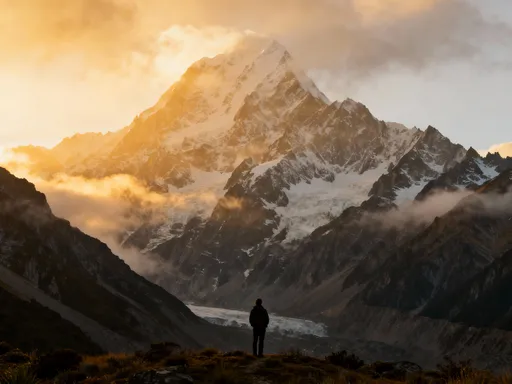
Standing beneath the towering peak of Aoraki/Mount Cook, I felt a deep sense of reverence I hadn’t expected. This isn’t just New Zealand’s highest mountain—it’s a living part of Māori heritage, wrapped in stories older than time. The viewing experience here goes beyond stunning alpine vistas; it’s about connection, silence, and cultural respect. What I witnessed changed how I see nature forever. If you're chasing beauty with meaning, this is where you need to be.
The First Glimpse: Arriving at Aoraki
As the winding road from Twizel climbs into the Southern Alps, the landscape begins to shift in subtle but profound ways. The golden tussock fields give way to jagged ridgelines, and the air grows crisper, carrying the faint scent of snow and stone. Then, just as the small alpine settlement of Mount Cook Village comes into view, the clouds part—and there it stands: Aoraki, its snow-capped summit piercing the sky like a sentinel of time. For many visitors, this first sighting is unforgettable, not only for its visual drama but for the quiet awe it inspires. Unlike other famous peaks that announce themselves through fanfare and crowds, Aoraki reveals itself with dignity and restraint.
What many travelers may not realize upon arrival is that they are entering a space of deep cultural significance. The mountain is officially known as Aoraki/Mount Cook, a dual name that reflects both its Māori and colonial histories. Aoraki is the name given by the Ngāi Tahu, the principal Māori iwi (tribe) of the South Island, and it carries with it centuries of ancestral memory and spiritual meaning. Mount Cook, named after British explorer Captain James Cook, represents a later chapter in the mountain’s story—one of exploration and mapping. Yet today, the dual naming is more than symbolic; it is an acknowledgment of coexistence, a reminder that this land holds multiple truths and layered histories.
Seeing Aoraki for the first time is not merely a scenic moment—it is a symbolic encounter. For the Ngāi Tahu, the mountain is not an object to be conquered or photographed, but a revered ancestor. This understanding transforms the experience of arrival. Visitors who take a moment to learn the name Aoraki, to pronounce it correctly (Ah-oh-rah-kee), and to reflect on its meaning often find that their perception of the landscape shifts immediately. The mountain is no longer just a backdrop for adventure; it becomes a presence, a teacher, a guardian. This shift in perspective is the first step toward a more meaningful journey.
More Than a Mountain: The Māori Story of Aoraki
At the heart of Aoraki’s significance is a creation story that has been passed down through generations of Ngāi Tahu. According to Māori tradition, Aoraki was once a young chief, the son of Rakinui, the Sky Father. Along with his three brothers, Aoraki sailed across the southern seas in their waka (canoe), but they drifted off course and became stranded on a reef. As they climbed onto the top of the canoe to pray for salvation, the waka capsized and turned to stone, becoming the South Island of New Zealand—Te Waipounamu, the Waters of Greenstone. The brothers, frozen in their final moments, became mountains, with Aoraki rising highest of all, his body forming the majestic peak now known to the world as Mount Cook.
This narrative is not a myth in the sense of fiction, but a cosmological truth that shapes the way Ngāi Tahu understand their relationship to the land. Aoraki is not a geological formation to be studied in isolation; he is an ancestor, a physical embodiment of divine origin. This worldview fosters a deep ethic of care and responsibility. To climb or walk near Aoraki is not a casual act—it is an interaction with whakapapa, or genealogy. The mountain is not separate from the people; it is part of their lineage. This understanding underpins much of the cultural and environmental stewardship practiced in the region today.
For visitors, learning this story transforms the way they see the landscape. When the summit disappears behind a veil of clouds, it is no longer a disappointment—it may be seen as Aoraki turning away, reminding people of his tapu, or sacredness. When the wind howls across the valleys, it might be heard as the breath of an elder. These interpretations are not superstitious; they are expressions of a worldview that sees nature as animate, interconnected, and worthy of reverence. By engaging with this story, travelers move beyond passive observation and enter into a relationship with the place—one built on respect, humility, and wonder.
Sacred Silence: The Cultural Etiquette of Observation
One of the most powerful lessons Aoraki teaches is the value of silence. In a world where travel is often measured by how many photos are taken or how many peaks are summited, Aoraki invites a different kind of engagement—one rooted in stillness and listening. For the Ngāi Tahu, the mountain is tapu, a term that conveys sacredness, restriction, and spiritual power. This means certain behaviors are not just discouraged; they are considered culturally inappropriate. Loud voices, music played in open areas, and especially the use of drones are seen as disruptive to the mountain’s mana, or spiritual authority.
Many visitors are unaware of these cultural expectations, assuming that because the area is a national park, it operates under standard tourism rules. But Aoraki is not just a park—it is a wāhi tapu, a sacred site. The Department of Conservation (DOC), which manages the area in partnership with Ngāi Tahu, has implemented guidelines that reflect this understanding. Signs at trailheads gently remind visitors to behave with respect, to avoid flying drones, and to keep noise levels low. These are not arbitrary rules; they are invitations to participate in a different way of being in nature—one that prioritizes reverence over recreation.
When travelers embrace this ethos, they often find their experience deepens in unexpected ways. Sitting quietly at the edge of the Tasman Glacier, watching the ice shift and crack under the morning light, becomes a meditative act. Walking the Hooker Valley Track without headphones allows the sounds of the river, the call of the kea, and the whisper of the wind to become part of the journey. This kind of presence enhances not only cultural understanding but personal awareness. Silence becomes a form of attention, a way of honoring the mountain on its own terms. In doing so, visitors may find that they are not just seeing Aoraki—they are being seen by it.
Where to Look: Best Spots for Meaningful Views
While Aoraki can be seen from various points around the village, certain vantage spots offer more than just a clear view—they provide space for reflection and connection. The Tasman Lake View Track, a short and accessible walk from the main road, is one of the most popular. From its wooden platform, visitors can see the milky-blue waters of the lake, fed by the retreating Tasman Glacier, with Aoraki rising dramatically in the background. What makes this spot special is not just the view, but the sense of scale it conveys—the mountain seems to float above the water, a mirage of ice and sky.
Another powerful location is Kea Point, a gentle 20-minute walk from the village center. Nestled in a natural amphitheater, this spot offers a panoramic view of Aoraki, Mount Tasman, and the surrounding peaks. At dawn, when the first light hits the snowfields, the mountains glow in hues of pink and gold—a phenomenon known locally as alpenglow. This moment is not just visually stunning; it carries emotional weight. Many visitors report feeling a sense of peace, even gratitude, as they witness the mountain awakening. It is a reminder that nature operates on its own rhythm, indifferent to human schedules but deeply attuned to cosmic cycles.
For those willing to walk a little farther, the Sealy Tarns Track offers a more immersive experience. The climb is steep, but each switchback reveals a new layer of the landscape—alpine herbs clinging to rocky outcrops, small tarns reflecting the sky, and, finally, the full face of Aoraki emerging above the valley. This journey mirrors the internal process of slowing down and becoming present. The physical effort enhances the emotional reward. Seasonal changes also affect the experience: in winter, the area is quieter, the snow amplifies the silence, and the mountain appears even more majestic. In summer, the thaw brings the sound of meltwater and the vibrant green of alpine vegetation. Each season offers a different way of knowing Aoraki.
Voice of the Land: Learning from Local Guides
One of the most transformative aspects of visiting Aoraki is the opportunity to learn directly from those who carry its stories. Māori cultural ambassadors, often affiliated with Ngāi Tahu or local tourism operators, lead guided walks and evening talks that share oral traditions, place names, and environmental knowledge. These guides do not simply recite facts; they offer a way of seeing. When they speak of Aoraki, they do so with the tone of someone speaking of a family elder—with warmth, respect, and deep familiarity.
Walking with a guide changes the texture of the journey. A simple rock formation becomes a marker of ancestral passage. A bird’s call is not just a sound, but a sign of the land’s vitality. These interpretations are not added on; they are part of an indigenous epistemology—a way of knowing that integrates observation, memory, and spirituality. For visitors, listening to these stories is an act of reciprocity. It acknowledges that knowledge is not something to be extracted, but shared with care and context.
Many travelers report that a single guided walk reshapes their entire trip. What was once a scenic hike becomes a cultural pilgrimage. The landscape gains depth, dimension, and emotional resonance. These guides often emphasize the importance of listening—not just to them, but to the land itself. They encourage questions, but also silence. They remind visitors that understanding does not always come through words, but through presence, patience, and openness. In a world where information is instant and abundant, this slower, more contemplative way of learning feels revolutionary.
Beyond the Postcard: How Culture Transforms Perception
Modern tourism often reduces destinations to images—perfectly framed photos shared on social media, chasing the ideal light, the clearest sky, the most dramatic angle. At Aoraki, this approach falls short. There are days when the summit is completely hidden by cloud, when rain turns trails to mud, when the wind makes walking difficult. To a conventional tourist, these might be seen as failed days. But to someone who has learned the stories of Aoraki, these conditions are not obstacles—they are part of the mountain’s character.
Knowing the legend of Aoraki, for instance, allows a visitor to interpret the weather as expression, not inconvenience. Clouds swirling around the peak might be seen as the mountain breathing, or turning away in tapu. Rain could be understood as a cleansing, a reminder of the mountain’s power. This shift from expectation to acceptance opens a deeper kind of engagement. It moves the traveler from seeking control to practicing humility. The view may be obscured, but the experience becomes richer.
This cultural lens enhances even the most familiar sights. The Tasman Glacier, one of the largest in New Zealand, is often described in terms of length and volume. But through a Māori perspective, it is also a living ancestor, part of the same waka that carried Aoraki and his brothers. Seeing it retreat due to climate change is not just an environmental concern—it is a cultural loss. This understanding fosters a more urgent sense of stewardship. Travelers who once came for the views may leave with a commitment to protect the place. Culture, in this way, does not just add meaning—it transforms behavior.
Bringing It Home: Travel That Respects and Remembers
The experience of standing before Aoraki stays with visitors long after they leave. It is not just the image of the mountain that lingers, but the feeling of reverence, the memory of silence, the weight of story. This is the power of culturally informed travel—it changes not only how we see places, but how we move through the world. Aoraki invites travelers to slow down, to listen, to acknowledge that some spaces are not meant to be dominated, but honored.
For future visitors, the lesson is clear: come with curiosity, but also with respect. Seek more than the perfect photo. Take time to learn the name Aoraki, to understand its story, to follow cultural guidelines not as rules, but as invitations. Support local Māori-led tourism initiatives, attend cultural talks, and ask questions with humility. These actions do more than enhance a trip—they contribute to a more ethical and sustainable form of travel.
And when you return home, carry that awareness forward. Share not just the images, but the stories. Teach your family why silence matters in certain places. Explain why drones are not allowed. Let the lessons of Aoraki shape your future journeys. Because travel at its best is not about collecting destinations—it is about deepening connection. Aoraki does not just show us a mountain; it shows us a way of being in relationship with the Earth. And that is a sight worth remembering for a lifetime.